About Us Resources Search Contact Us    
   
Sailing
In The Spotlight
FULL AND BY
By Bill Schanen

View The Archives »


MinistryPresence (Design #6) Current Issue


A daysailer of timeless beauty, a designer’s legacy

It was Carl Schumacher.

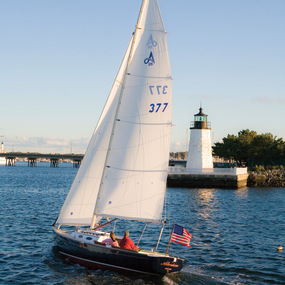
It was Carl Schumacher who designed what more than a few people will tell you is the most beautiful sailboat you can buy.

I omitted this fact in a column I wrote five years ago, and Ralph Schacter has been giving me hell for it ever since.

The subject came up recently when Ralph and I talked after hearing the sad news that Schumacher had died at the young age of 52. That beautiful sailboat, the Alerion-Express 28, is now Schumacher’s legacy.

I wrote in 1997 that the Alerion-Express was “the perfect wedding of form and function” in a sailboat. It was just a passing reference in a column about sailboat aesthetics, so the omission of the designer’s name wasn’t a big deal. Except to my friend Schacter. His sensitivity, though, was understandable—the boat was in many ways his baby, and it led to a friendship with Schumacher that endured until his death.

In the mid-1980s, Schacter owned an Express 27, one of the ultralight racing boats designed by an Alameda, California, yacht designer by the name of Carl Schumacher. Schacter loved the boat, but he was tired of racing. He didn’t want to give up the speed of the Express, but he wanted a boat that was easier to sail alone or with a few friends and was pretty in the classic sense, a boat that would evoke the spirit of Nathanael G. Herreshoff’s legendary daysailer Alerion. He presented the conundrum to Schumacher.

To say that Schumacher responded with drawings of a 28-foot daysailer that combined a traditional look above the water with a modern underbody would be accurate, but wouldn’t begin to explain the magic of the Alerion-Express.

Under the water, the design owes nothing to Herreshoff. In place of Alerion’s long canoe form with centerboard, it has a shallow hull with high-performance appendages reminiscent of the Express 27.

Above the water is where the magic is. The look is clearly derived from Alerion, but with no disrespect to Capt. Nat intended, the Alerion-Express is better looking than his 1913 daysailer. The lines, from the eager bow to the shapely counter stern, are a study in harmony and moderation. The fractional rig and the absence of stanchions and lifelines and other clutter add to the impression of perfect proportion. Even at anchor—just add an ensign snapping in the breeze—this is a boat whose looks stir the soul of a sailor.

It would be a mistake, though, to think of the boat as just an ornament. Beneath its comely skin, it’s a practical sailboat that serves its purpose efficiently—to sail fast and nimbly with little fuss and ample comfort for daysailing with a deep, spacious cockpit.

With Schumacher’s plans in hand, Schacter, then recently retired from his Connecticut construction business, went into the sailboat business. A backyard builder in Stuart, Florida, was engaged to build the prototype, with lots of hands-on help from Schacter and Schumacher. About a half a dozen production models were then built in Barrett Holby’s plant in Bristol, Rhode Island, before Everett Pearson of TPI Composites bought the molds. (Paying tribute to Schumacher after his death, Pearson, a pioneer of the fiberlgass boatbuilding industry, said that of all the boats he had built, “the looks and sailing qualities of the Alerion-Express were unsurpassed.”) Now under the stewardship of Garry Hoyt, the boat continues to sell steadily.

Though Hoyt praises the boat’s sailing ability to the point of it declaring it the best balanced boat he’s ever sailed (“steers itself on a reach”), I like to think a good many sales are made just because the boat is a thing of beauty. This is a bracing thought at a time when sailboat aesthetics have slipped a bit—understandably: With buyers demanding ever more homelike space, furnishings and appliances belowdecks, great looks can hardly be a top priority in production cruising boats. The lines of racing boats, on the other hand, are purely a function of the need for speed, and the results can be visually pleasing, though certainly not in the traditional sense of sailboat beauty. Even with their gauche paint jobs, the Open Class 60s might be considered pretty boats—in the way F16s could be considered pretty airplanes.

Of all unlikely places, the realm of powerboats is showing us that aesthetics can have commercial appeal. Unlikely because this is a place populated by objects that must rank among the most atrocious looking made by man. The bulbous forms of some popular contemporary powerboats tower over the water to absurd heights—perhaps in the manner of high-rise condos, to guarantee their owners the best views in the marina.

It is a blessed relief to the eye to find among these monstrosities, thriving like delicate blossoms in fields of nettles, examples of the stylish class of powerboats called picnic boats. Low and rakish like a Depression era rumrunner, these sleek vessels have, like the Alerion-Express, a practical side—a high-performance underbody with propless jet-drive propulsion. But I’m guessing that most people buy them—at rather breathtaking prices—for the look. So appealing is that look that Hinckley, the Maine boatbuilder whose reputation was heretofore based on building handsome sailboats, can’t turn out these handsome powerboats fast enough to meet the demand.

When cost doesn’t matter, aesthetics flourish. Megayachts that look like early 20th century sailing ships above water but have state-of-the-art, high-performance hulls below the waterline are quite the fad in Europe. These are fabulous vessels to see, but even they, to my eye, do not capture timeless sailboat beauty the way Schumacher’s little yacht does.

I didn’t know Carl Schumacher personally. I’ve learned since his death that he was admired by many in the world of sailing not just for being a talented and imaginative designer but also as, in the words of Garry Hoyt, “a nice guy without a touch of arrogance whose enthusiasm for sailing matched his extensive knowledge.” Ralph Schacter, who will miss the sailing outing he organized every year with Schumacher and a Swedish sailor who was one of the first Alerion-Express owners, said of the designer, “If you knew him you had to be touched by him . . . his modesty, everything he knew about sailing.”

That’s how his friends remember him. The rest of us can remember him as the author of the lines of a sailboat that will always be described with one word—beautiful.

Subscribe

Links

Back Issues

View The Archives »
 
SAILING Magazine
P.O. Box 249 • Port Washington, WI 53074
Phone: 262-284-3494 • Fax: 262-284-7764
E-mail: general@sailingmagazine.net