|
Current Issue
|
I remember sailing that boat for its simplicity bordering on purity. There was never much fuss or elaborate planning. We would just jump in the boat, pull up the sails and sail away.
|
|
 |
Memories of simple sailing survive bites of the big-boat bug
The bigger-boat virus is a well-documented malady among sailboat owners. The afflicted are obsessed with the belief that the pleasure of sailing increases with the size of the boat. There is no cure, though symptoms subside for a while after the purchase of a bigger boat.
Consider the sad case of Joe Vittoria, perhaps the worst in the annals of the disease. Joe, who made boatloads of money when he sold the Avis car rental empire in 1987, owns not one, but two sailboats named Mirabella. Since they are both 140 feet long, one would have thought his sailing pleasure cup was running over. But grandness, even when multiplied by two, confers no immunity. Joe caught such a bad case of the virus that he ordered up the biggest sloop in the world.
Mirabella V was recently launched in England. Here are some of the ways it redefines the term megayacht: Its 300-foot mast is taller than any other sailboat mast ever built and is the biggest carbon fiber object ever made. Its 10 spreaders are so big a man could lie on one and not be seen from the deck. At 247 feet long, the hull is the biggest ever built of composite. Its 17,366 square-foot reacher is the biggest sail ever made. The section of shroud from the first spreader to the deck weighs 1 ton. Seven boats, including a 29-foot, 400-horsepower Hinckley tender, fit in the garage forward of the transom. The boat is too big (meaning tall) to get through the Panama Canal or under the Golden Gate Bridge. The price paid for this temporary relief from the virus was big too$45 million.
I have a lot of empathy for Mirabella’s owner. After all, I’m a fellow sufferer. But at least I have made some progress. I’ve accepted as truth the belief that you can enjoy sailing as much in a small, simple boat as in a big, complicated one. Small-boat aficionados have been telling me that for a long time, and my own experience, increasingly burnished by nostalgia as the memories get older, backs it up.
Our first boatthe first one big enough to sleep in overnight, that iswould have fit in Mirabella’s garage. I found it in a classified ad in a then-upstart magazine called SAILING while checking paste-ups of the brokerage pages. (Apple computers with publishing software were not even a gleam in a nerd’s eye back then.)
I had no business even dreaming of owning a cruising-racing sailboat, given certain economic realities. But a word and a number in the ad blew away any notions of financial responsibility: Yankee 30.
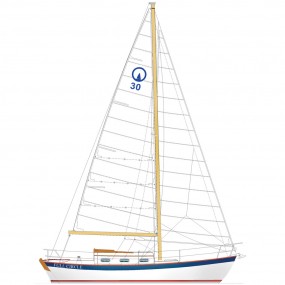
Yankee was a California boatbuilder that produced well-built sailboats in the 1970s. The name set my imagination on fire because I knew Yankee built only Sparkman & Stephens designs. The lines of the Yankee 30 had been drawn, or at least refined and approved, by the reigning genius of high-performance sailboat design, Olin Stephens. Could I actually own a boat designed by the master? How could I not? I asked myself persuasively.
It all fell together with serendipitous ease. I made my move before the magazine went to press, lest some reader lusting for an S&S pedigree steal my boat. It turned out the boat was owned by two friends in an arrangement that wasn’t working out and was priced attractively to quickly dissolve the partnership. What’s more, it had hardly been sailed. Indeed, a major selling point was the head had not yet had its maiden flush. The deal was done.
Our Yankee 30 was in truth a plain jane. The gelcoat was tinted the nondescript shade of ivory that was the hue of choice for apartment walls of the period. Down below, the upholstery was a gauche brown and yellow plaid. I didn’t care. All that mattered was that her lines bespoke S&S character.
The owners had added nothing to the basic boat except a depthsounder and, odd in a 30-footer, a steering wheel. It was tiny, about the size of the steering wheel of the Corvair convertible I was driving at the time.
That wheel might have looked silly, but I was one proud captain standing behind it as we (the mate was my mate and brave partner in this adventure in boat ownership) powered away from the boatyard on the inaugural passage to our home port. The magic of the moment lasted until we reached the busy harbor entrance, where the Atomic Four auxiliary petered out and the proud captain became a humble, grease-smeared boat maintenance worker (who, mostly by luck, determined the problem to be water in the carburetor). It was a role I would get used to.
I marvel now, as one who in later years contributed with remarkable generosity to the financial health of several boatyards, at what a no-frills operation the first boat was. Its mooring was free because it was at a rude commercial fishing dock in a harbor vulnerable to stomach-turning surge and prone to being swept by late season storms. Haul-out and launching were handled through a co-op of boat owners. We shared the cost of a crane and the bull-work of moving the boats around on skids.
Bottom painting, teak varnishing and engine servicing were do-it-myself jobs. I did semi-skilled work as well, though always with trepidation. Cutting a hole in the cockpit bulkhead for a Kenyon speedometer was a dangerous, though ultimately successful, mission.
Upgrading the equipment whenever I was able to was part of the fun. I once installed a device that would probably defy identification if it turned up in a sailor’s flea market today. A husky steel wheel that turned on a thick screw, it looked like something scavenged from a steam engine. It was a backstay adjustor, then the state of the art.
The Yankee 30 taught me that pottering around on a boat is a reward of boat ownership in its own right. But most of all it reinforced that the ultimate reward is the sailing. I remember sailing that boat for its simplicity bordering on purity. There was never much fuss or elaborate planning. We would just jump in the boat, pull up the sails and sail away. I am still amazed at how much we sailed and how far we sailed, rarely using the engine, daysailing, cruising, living aboard, cooking in the cramped little galley, with never a care for how fast the hours or the miles were going by.
The boat’s waterline length was a scant 22 feet. Five knots was a burst of speed. Yet I don’t recall ever thinking, as I have often since on bigger, much faster boats . . . this is taking forever. I know why: We were so besotted by the joy of sailing we didn’t want it to end. Why would we want to go faster and get off the water sooner?
That was many years and many boats ago. I succumbed to the bigger-boat virus four years after the fateful discovery of that classified ad and have remained off and on in its thrall.
Don’t get me wrong. I don’t regret it. I could produce a list of reasons right now why we should move up to yet another bigger boat. But I do know that no matter how wonderful andpick the adjectivesfast, high-tech, lavish or beautiful such a boat would be, sailing it would never surpass the experience of those idyllic days and nights on that first, small boat.
|
 |