About Us Resources Search Contact Us    
   
Sailing
In The Spotlight
FULL AND BY
By Bill Schanen

View The Archives »


MinistryPresence (Design #6) Current Issue


A dose on the nose is a tonic for the sailing soul

"If, as the saying goes, gentlemen never sail to weather, how do these well-bred sailors ever get to an upwind destination? I suppose they don’t—they just change the destination to one that is reach-able.

You don’t have to be a gentleman, of course, to prefer the breeze on the beam rather than on the nose. Not for nothing do we call the upwind point of sailing beating. Beating as in taking a beating: An in-the-face assault by wind, spray and solid water endured while resisting gravity in a tilting vessel pounding into waves with impacts so concussive they threaten to remove tooth fillings, all the while making demoralizingly slow progress toward a destination.

It is no wonder there are cruising sailors who have devoted their voyaging lives to avoiding windward sailing, some managing to get around the world without ever sheeting in for a beat. Even long-distance racing sailors eschew beating, knowing it is more profitable (not to mention less miserable) to sail fast some degrees wide of a true beating angle and wait for the virtually inevitable wind shift to efficiently get to a distant mark.

Now it is true that course racers revel in the beat, for this is where their carefully plotted strategy and tactics come into full flower. It should also be noted, though, that another factor adds to the appeal of the beat in around-the-buoys racing—with the windward mark only a mile or so from the starting line, it is always short.

It’s another story when the windward mark is 65 nautical miles away from starting line. I know something about that story, having recently finished a race in which the windward leg was precisely that length. I recommend the experience as a purifying tonic for sailors in danger of getting soft in the reaching life.

This race, in fact, started with a promising reach, which lasted just long enough to raise expectations for a quick passage. But after a few miles of free-sheeted joy, a fast-passing weather front adjusted the wind with uncanny precision to blow directly from the finish line. This was not a case of the wind being generally on the nose, or on one side of the nose of the other. It was perfectly centered on the nose. No race committee, no matter how much anal-retentive zeal it applied to capturing the holy grail of setting the perfect windward leg, could have placed a mark more squarely to weather than, by whim of nature, was our distant finish line. Truly, there was no favored board in this race.

We adjusted the boat and sails—mainsheet, genoa sheet, genoa halyard, backstay, running backstay, cunningham, outhaul—to the new weather. That was easy; adjusting our psyches was not. The brisk 18-knot breeze (which built to 28 knots by the time we crossed the finish line) sent messages that we should be sailing faster than the puny numbers the instruments registered. The speed, alas, was right for the conditions.

Even harder to swallow was the dreaded VMG, the velocity made good toward the finish line, which computed to something between 5 and 6 knots, verified by the cockpit GPS readout counting off the tenths of miles to the finish at the pace of a badly out-of-shape jogger.

This was tough to take because, like many sailors today, we are spoiled, thoroughly corrupted by speed. Ever since the law of hull speed was revoked, we expect to go fast. The rigid rules of physics that once ordained that a displacement hull could not exceed a speed determined by a mathematical formula don’t apply to the newest generation of performance designs with their shallow hulls and fine appendages.
These days you don’t even need surfing waves to defeat hull speed. In breaking the elapsed time record last winter in the Miami to Montego Bay race, Zephyrus V reported sailing at a speed of 22 knots in 20 knots of wind on flat water, almost twice her theoretical hull speed.

This is true even for boats less awe-inspiring than a turbocharged 86-footer liked ZV. I remember when crews on boats I sailed with would break into cheers when the speedometer flashed double digits. Now any time the wind is aft of the beam on our boat, such speeds are so routine they don’t raise an eyebrow.
As we settled in for our long beat, we weren’t cheering, but we were coming to terms with the one point of sailing where the old rules still apply. Upwind, we were going to go only so fast; we had to make the best of it. This was a more challenging proposition than you might think because this was a doublehanded race. Instead of the usual complement of 12, it was just my son and me.

We had plenty to do, the helmsman absorbing data from a panoply of sources—speed, target speed and wind angle from the instruments, information from the telltales and Windex, heeling angle and wave frequency and height gathered from his view across the windward deck, plus all manner of unspecified, intuitive intelligence from the seat of the pants—and the crew’s hands literally full trimming two sails and tweaking backstays.

The hours passed with surprising alacrity. Oddly, in spite of the cold wind in our faces and the occasional dollop of 49-degree water flung from the bow, we were having fun. So, it seemed, was the boat, which was so lively and responsive as she glided through and over the waves that it was as though she were showing off the work of the human and electronic brains that designed her elegant foils and appendages. Upwind is the place to do that. When reaching, after all, the sails are but wind catchers and the rudder and keel serve mundane functions of direction and stability. On the wind, the sails get to generate lift like airplane wings; the rudder and keel can do the same underwater.

On we sailed into the freshening breeze, changing to a smaller headsail, tacking on vanishing headers we hoped in vain would evolve into lasting shifts that would improve the discouraging geometry of a square beat. Still, it was exhilarating sailing, and the miles passed, if not quickly, at least steadily. If we had a bottle of champagne aboard, we would have popped the cork when we the GPS announced 10 miles to the finish.
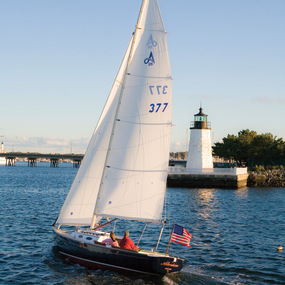
At last, beside a familiar pierhead lighthouse, in front of the setting sun, the finish line was in sight. We crossed it in a shuddering puff, dipping our rail as in salute to the race committee’s finish horn. We were elated, not because the long beat was over, but because we had sailed it.

On shore, instead of high-fives we got some good-natured joshing. The race offered a choice of two courses of the same length, one coastwise, the other across open water. We had opted for the latter, reasoning that it was more likely to produce the reaching breeze in which our boat excels. (Yeah, and I picked New Zealand to win the last America’s Cup too.)

The skippers who made the brilliant decision to sail the shore course were rewarded with a rousing, reaching sprint so fast that all, save a 25-foot catboat, finished before the first boat (our 48-footer) in the offshore fleet.

I’m not sure anyone believed us when we said we were glad we had the challenge of a day of upwind sailing rather than an easy point-and-shoot reach, but we meant it.

If I wax too romantic about the rewards of beating, forgive me. I don’t mean to be an evangelist for on-the-nose sailing. That fine day in the doublehanded race was about as much of it as I want to do at one time. And I’m pretty sure that if I had to, say, beat from Newport to Bermuda, I would probably be considering the equestrian arts as an alternative recreation to sailing.

But, in measured doses, I have to say, beating is good for the sailing soul.

Subscribe

Links

Back Issues

View The Archives »
 
SAILING Magazine
P.O. Box 249 • Port Washington, WI 53074
Phone: 262-284-3494 • Fax: 262-284-7764
E-mail: general@sailingmagazine.net