About Us Resources Search Contact Us    
   
Sailing
In The Spotlight
FULL AND BY
By Bill Schanen

View The Archives »


MinistryPresence (Design #6) Current Issue


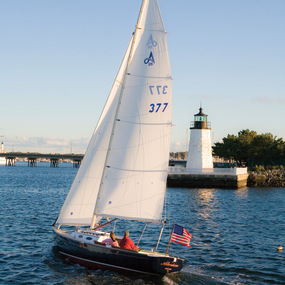
I imagine we look pretty much like the photos in the ads—the boat sailing at speed with dodger in place, non-overlapping roller-furling headsail drawing nicely, and two happy people comfortably ensconced in the protected cockpit.

When rating rules fail, there’s always the dodger handicap

I dreamed that dodgers were required for the Chicago-Mackinac Race.

No kidding. I’m not making this up. I couldn’t have imagined anything so ridiculous if it hadn’t come to me in a dream.

In the dream, I was studying the long list of safety regulations for the race and came across item number 5.19 under modifications to the international offshore safety rules: “Dodgers—every boat shall have a dodger installed over the companionway with a minimum width of .75 of the beam and a height of 4 feet above the cockpit sole.” Still in my dream, I stood up, raised my fist in the air and shouted, “Take that, Transpac 52s.”

I guess that shows where my head was before the race. About the time I had the dream, a fleet of TP52s was on trucks bound for Chicago to sail in the same Mackinac Race section as our boat. Whether on trucks or on the water, these boats easily vie for the title of most elegant offshore racer extant—elegant not just in looks, but in performance. Sometimes they seem to go as fast on the water as they do on a truck. They take sleekness to a new dimension. Their cabintops are but a subtle rising of the deck amidships. Control lines hide under the deck. All is smooth and slick, aerodynamically wonderful. Putting a dodger—a tentlike affair to shelter the cockpit—on this boat would be like welding a minivan body to a Porsche.

The boat I sail, on the other hand, came with a dodger as standard equipment. It is the first boat I’ve ever owned that had this amenity, and I’ve become quite fond of it. It has taken me a while to realize that the exhilaration of wind and spray in your face is overrated. But of course we don’t carry the dodger while racing. It comes with too much baggage—all that weight, windage and clutter. That’s what made my dream of inflicting dodgers on the TP52s such a delicious fantasy.

Not that I have anything against TP52s. In fact, I’m a big fan of these dazzling sailing machines. I like the way TP52s showcase the ability of various designers to find sailing speed. They do this better than most racing boats because the class has simple parameters, none of which involves pulling punches to get favorable treatment by rating or handicap systems.

TP52s spring from what’s called a box rule, which says they can’t be longer than 52 feet or wider than 14.5 feet. Their draft is set at 10.5 feet and they have to weigh between 16,500 and 17,500 pounds. There’s a maximum allowable sail area, and that’s about it. The challenge to designers is to cram as much speed into that box as possible.

What comes out of the box is an arresting sight to behold and a handsome one if you subscribe to the form-follows-function school of design. To appreciate the look, you have to be ready to accept waterline lengths so long (the box puts no limits on this dimension) that some TP52s have a reverse bow angle—the bows lean backward.

To any eye, however, the boats’ performance has to be pretty. The box might be able to contain TP52s, but handicapping systems can’t. They’ve won under five different rating rules that I can think of—quite an irony in that the box-rule concept thumbs its nose at rating rules. This may explain why I dreamed that they should be properly handicapped—with dodgers.

I don’t want to give the impression that because my boat came with a dodger it’s a sedate cruiser. Far from it, it’s a fast, high-tech racer-cruiser with a powerful sailplan, rather lightweight hull and long sailing length (even so the boat weighs about a ton more than a TP52 with 10 feet less waterline length). The dodger and something even more surprising on a boat designed to race extensively—roller furling as standard equipment—are quirky features that express the philosophy of the boat’s maker, J Boats, that high-performance sailing and a modicum of comfort and convenience don’t have to be mutually exclusive.

The philosophy is articulated in the handsomely crafted copy in J Boats ads, which persuasively delivers the message that the advertised model is fast and competitive on the race course, but also civilized and easy to handle, even short-handed. Our boat has often been sailed by just two of us—the first mate/co-owner and I—so I can vouch for the ad claims. (Just don’t ask the 115-pound first mate/co-owner about flaking the mainsail on the 21-foot boom.) I imagine we look pretty much like the photos in the ads—the boat sailing at speed with dodger in place, non-overlapping roller-furling headsail drawing nicely, and two happy people comfortably ensconced in the protected cockpit.

While this is an accurate picture, it should be noted that it portrays the cruising and daysailing mode. When it’s time to race, we welcome 10 close friends and a truckload of sails aboard, and say goodbye to the dodger, roller furling, spinnaker snuffer, wine glasses, potted plants, etc., etc. This is the way of life on a hyphenated boat. The fully equipped galley, large head compartment with shower stall and cherry-paneled saloon stay, of course.

No such logistical challenges face TP52s. They’re always in racing mode. And there’s certainly nothing to remove from below, since their interiors could pass for a Guantanamo Bay interrogation cell.

The TP52s were a splendid sight as they passed us in the Mackinac Race, knifing through bumpy seas with muscular grace. I can report that their rakish profiles were not distorted by dodgers—my dream didn’t come true. Something else happened, though. The race committee decided to put the TP52s and other exotic racers in a separate “turbo” class, so we didn’t have to race against them for class honors. All things considered, a better idea than the dodger handicap.

Subscribe

Links

Back Issues

View The Archives »
 
SAILING Magazine
P.O. Box 249 • Port Washington, WI 53074
Phone: 262-284-3494 • Fax: 262-284-7764
E-mail: general@sailingmagazine.net